
December 3, 2025
Introduction
Generic and widely used terms cannot be monopolized by a single owner, according to a well-established principle of trademark law, since doing so would defeat the Trade Marks Act, 1999’s main goal. The purpose of trademark protection is not to award exclusive rights over common dictionary words that traders and the general public must continue to use, but rather to protect unique marks that indicate the business origin of goods or services.
A monopoly on such generic terms would restrict the vocabulary available for ethical corporate operations and impede fair competition. The present issue directly deals with this principle, as the disagreement largely focuses around the use of the common word “DOCTOR” inside rival marks and whether such usage can form the basis of exclusive intellectual rights.
The Dispute
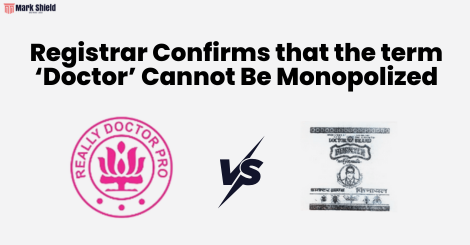
The prima facie dispute in the current case revolves around an allegation of misleading resemblance and potential misunderstanding in the marketplace. The present matter concerns an application No. 3644001 submitted under the Trade Marks Act, 1999, seeking the registration of the mark “REALLY DOCTOR PRO” in Class 3, which includes toilet cleaners.
The application was subsequently advertised in the Trade Marks Journal, opening the opportunity for public opposition. Vikrant Chemico Industries (P) Ltd. filed Opposition No. 1069329 in response to the publication, contesting the mark’s registration on several grounds.
The ultimate claim made by the opponent was that the applicant’s mark would mislead the public and infringe upon the opponent’s established goodwill since it is deceptively similar and difficult to distinguish from the opponent’s already registered trademark “DOCTOR” in Class 5.
Contentions made by the Opponent
The opponent’s counsel presented a detailed argument outlining numerous points of contention. They argued that the applicant had chosen a mark that included the word “DOCTOR,” which is the primary and only component of the opponent’s registered trademark widely used in India for Class 5 goods including phenyl and floor cleaners.
It was contended that the previously registered trademarks are either identical to or deceptively similar to the impugned mark. The opponent alleged that the applicant had intentionally adopted the impugned mark to benefit from the opponent’s goodwill, asserting that the impugned mark fully incorporates the opponent’s mark.
The opponent further emphasized that the goods marketed under both marks are similar, allied, or closely related—such as toilet cleansers, floor cleaners, phenyl, and phenyl concentrate—raising a likelihood of consumer confusion. The counsel claimed that the prominent shared element “DOCTOR” would lead consumers to associate the applicant’s goods with the opponent, suggesting unfair economic advantage.
Applicant’s Defenses
The applicant, represented by Adv. Naseem Sheikh, argued that the opposition was baseless and should be dismissed. It was stated that the mark “REALLY DOCTOR PRO” was adopted honestly and in good faith. The counsel highlighted that the disputed mark is visually, phonetically, and structurally distinct from the opponent’s mark and emphasized that the opponent cannot claim exclusive rights over the common word “DOCTOR,” which is widely used across various trademarks and everyday language.
The applicant also argued that confusion was unlikely because the goods—Class 3 toilet cleaners—differ significantly from the opponent’s Class 5 products. The counsel invoked the principle of “Anti-Dissection,” asserting that marks must be compared as a whole rather than dissected into parts. Additionally, no evidence of actual confusion was presented by the opponent.
Decision and Reasoning of the Registrar
After reviewing the pleadings, documents, and marks, the Registrar observed significant differences between “REALLY DOCTOR PRO” and the opponent’s marks. It was noted:
“The marks when compared as a whole are very different… The impugned mark is a device mark in which ‘REALLY DOCTOR PRO’ is written under a pink circle in pink color around the element of lotus. Conversely, the opponent’s marks consist of label marks and product packaging with multiple elements and detailed text, including ‘DOCTOR BRAND PHENYL’ along with a picture of a man.”
Thus, the marks were found neither visually nor structurally similar, eliminating any reasonable likelihood of confusion.
Phonetically, the Registrar noted that while both marks contain the word “DOCTOR,” the overall impression is distinct due to added words like “REALLY” and “PRO,” as well as the stylized presentation.
The Registrar relied on the Supreme Court judgment in Corn Products vs Shangrila Food Products Ltd., AIR 1960 SC 142, which states that when a common element appears in numerous market trademarks, consumers focus more on distinguishing features. Applying this principle, the Registrar held that differences in color, design, words, and overall appearance sufficiently prevent confusion.
The Registrar also emphasized that the opponent’s registration included a limitation specifying no exclusive rights over descriptive matter—further weakening their claim to monopolize “DOCTOR.”
Distinguishing the goods in question, the Registrar noted that the applicant’s Class 3 toilet cleaners differ chemically and commercially from the opponent’s Class 5 phenyl products, reducing the likelihood of confusion.
Finally, there was no evidence of bad faith or copying by the applicant.
In conclusion, the Registrar found no likelihood of deception or confusion after considering all relevant factors—visual and phonetic distinctions, market differences, the generic character of the word “DOCTOR,” and lack of mala fide intent. Accordingly, the opposition by Vikrant Chemico Industries (P) Ltd. was dismissed, and the application for “REALLY DOCTOR PRO” by M/s Jaideep Rastogi was accepted.
Mark Shield was pleased to represent and assist the Applicant in this matter.
